A sales representative has a chatbot draft a quote email. A colleague from the purchasing department uploads a supplier contract to have it summarized. In marketing, a press release is translated using AI. None of these steps is malicious; they all save time. And yet this is exactly how shadow AI arises: the use of AI tools that the organization is unaware of and that no one controls.
Our experience from audits and consulting projects consistently reveals the same pattern: Many companies are using significantly more AI applications than their IT and management teams realize. This article explains why “shadow AI” poses a risk to information security and compliance, and what practical AI governance looks like.
What is Shadow AI?
The term “shadow AI” is modeled after the well-known concept of “shadow IT.” It refers to AI tools that employees use without authorization, without review, and often without the IT department’s knowledge. These range from free chatbots in the browser to AI features in software already in use, to browser extensions that automatically rewrite text.
Why Employees Turn to Unapproved Tools
The driving force is almost always efficiency. AI tools are easily accessible, often free, and deliver results in seconds that used to take half an hour. If a company doesn’t provide approved alternatives or clear guidelines, employees will seek out their own solutions. A blanket ban does little to change this. It usually just shifts usage to personal devices and makes shadow AI even more invisible.
What Risks Does Shadow AI Pose to Information Security?
The problem is not the technology itself, but a lack of transparency. As long as no one knows which tools are being used, the associated risks cannot be assessed or addressed.
Confidential data leaves the company
Anyone who copies a contract, customer data, or internal design details into a public AI tool is disclosing this information to an external provider. Depending on the terms of use, the input data may be stored, analyzed, or used to train additional models. From an information security perspective, this means that data leaves the controlled environment without any consideration of classification, risk assessment, or a data processing agreement. Especially in companies subject to TISAX or NIS 2 requirements, this can quickly lead to a data breach or an audit finding.
Inaccurate Results and Unclear Accountability
AI models can generate content that sounds convincing but is incorrect. If someone includes an incorrect translation in a client document or an inaccurate summary in a decision-making proposal, the question arises as to who is responsible. Without defined review processes and assigned responsibilities, this question often remains unanswered until damage has already been done.
Compliance requirements are not being met
Regulatory pressure is also mounting. The GDPR naturally applies to personal data entered into AI tools as well. Furthermore, the European AI Act has required companies to promote AI literacy among their employees since February 2025. Those who do not know which AI systems are being used will find it nearly impossible to fulfill such obligations in a transparent manner. “Shadow AI” thus also becomes a compliance risk.
What AI Governance Must Do to Combat Shadow AI
AI governance does not mean putting the brakes on innovation. The goal is to establish a clear framework so that employees can use AI safely and productively. In practice, several key components have proven effective.
Creating Transparency and Bringing Shadow AI to Light
The first step is to take stock of the situation. A brief, anonymous survey of employees, supplemented by analyses of proxy or firewall logs, often reveals surprisingly quickly which tools are actually being used. It is important not to present this survey as a form of monitoring, but rather as an invitation to dialogue.
Approved tools and clear usage guidelines
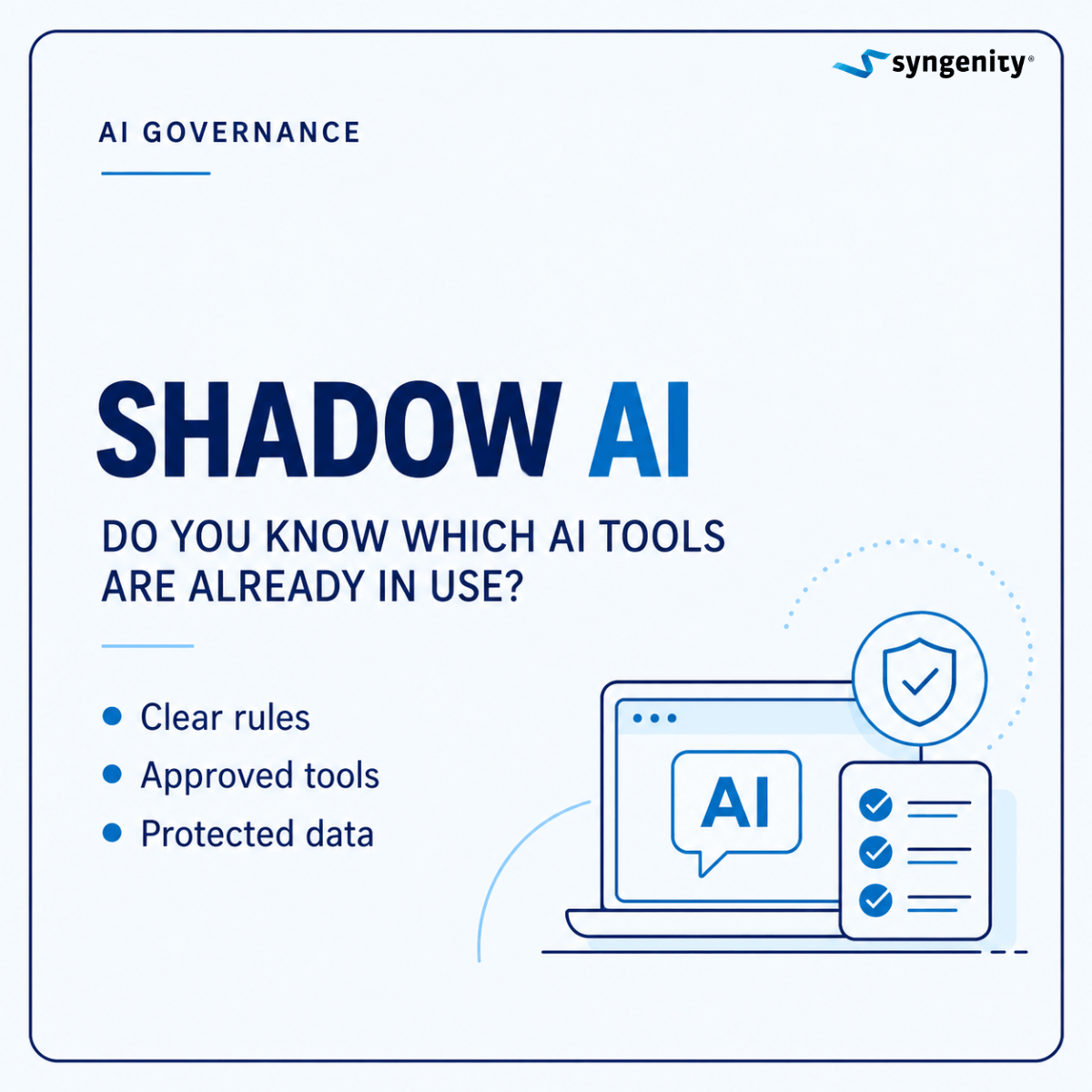
Anyone who wants to effectively reduce “shadow AI” needs attractive alternatives. Companies should provide vetted AI tools and establish clear guidelines specifying what data may be entered, how results should be reviewed, and when labeling is required. A simple traffic-light system based on protection classes—namely, public, internal, and confidential—is more helpful in day-to-day work than a twenty-page set of rules.
Responsibilities and Risk-Based Processes
Robust AI governance includes designated responsible parties, an approval process for new tools, and a risk assessment aligned with existing ISMS processes. Organizations that already operate in accordance with ISO 27001 can reuse many of their existing structures, such as supplier management or risk analysis. In addition, the ISO/IEC 42001 standard provides a framework for a dedicated AI management system that integrates well with an existing ISMS.
Training and Awareness-Raising
Rules are only effective if they are understood. Short, practical training sessions with examples from employees’ own daily work promote AI literacy, as required by the AI Act, while also reducing the risk of unintended data leaks.
Shadow AI in Practice: A Typical Scenario
A medium-sized mechanical engineering company discovers through an internal survey that about a dozen different AI tools are in use, ranging from translation services to code assistants. Instead of banning everything, the company approves two vetted tools, introduces a one-page usage policy, and raises awareness among all teams through a brief training session. After a few weeks, the use of unapproved tools drops significantly, and the IT department has a complete overview for the first time. Shadow AI has not completely disappeared, but it has become visible and manageable.
At Syngenity, we help companies establish practical frameworks for AI governance: from clear usage policies to risk-based processes and the definition of responsibilities.
Conclusion: Shadow AI Needs Governance, Not Bans
AI has long been part of everyday work at many companies, whether officially recognized or not. What matters is whether its use is transparent, controlled, and in line with information security and compliance. Shadow AI does not arise from malicious intent, but from a lack of rules and a lack of alternatives. Those who ensure transparency, provide vetted tools, and clearly define responsibilities can turn an uncontrolled risk into a real productivity gain. AI needs more than just implementation. It needs governance.